Total Transparency in Supplements: Third-Party Testing, GMP Compliance, and Certified Quality
Written by Dr. Leandro Cordova, Ph.D. — Co-Founder & Formulation Scientist at Proven Science Nutrition Science First. Results Always.
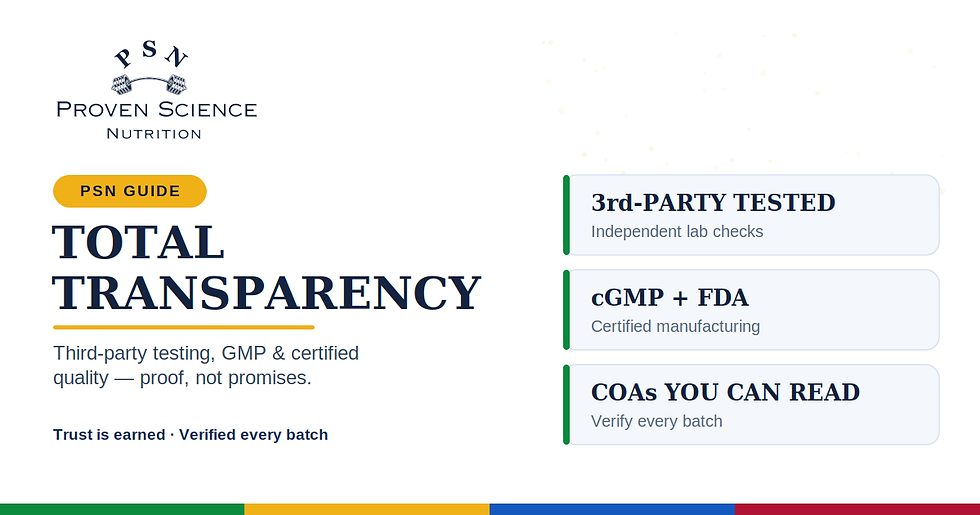
In the supplement industry, trust is earned, not assumed. Consumers today want proof, not promises — and they're right to. When you swallow a capsule or scoop a powder, you're taking it on faith that what's on the label is what's in the bottle. The uncomfortable reality is that, without independent verification, that faith is often misplaced.
This is why transparency sits at the center of everything we do at Proven Science Nutrition. Let me explain what real transparency looks like — third-party testing, certified manufacturing, and accessible clinical data — and why each piece matters for what you actually put in your body.
Why Transparency Matters: Supplements Aren't Pre-Approved
Here's something most people don't realize: in the United States, dietary supplements do not require pre-market approval from the FDA. Unlike prescription drugs, a supplement doesn't have to prove its safety, potency, or accuracy before it goes on sale. The FDA regulates supplements, but largely after they're already on the market.
That regulatory gap puts the burden of proof on the manufacturer — and, too often, on you. It's exactly why independent, third-party verification isn't a nice-to-have. It's the only thing standing between a label claim and the truth.
What Independent Testing Actually Finds
This isn't a hypothetical concern. When researchers independently test what's on the shelf, the results are sobering.
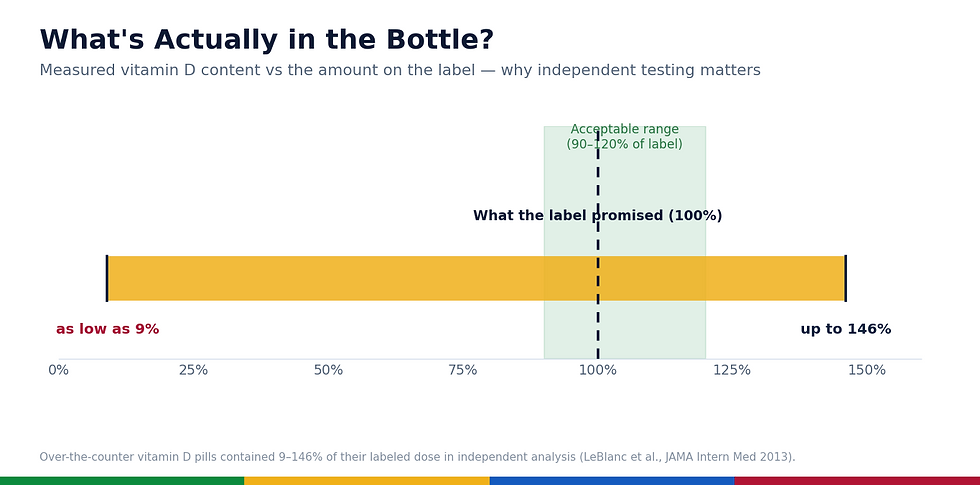
In one analysis of over-the-counter vitamin D supplements, the actual content ranged from just 9% to 146% of the amount stated on the label — meaning some pills contained a fraction of their claim while others contained far more.[2]
Contamination is a problem, too. In a landmark international study, roughly 15% of tested sports supplements contained anabolic steroids or prohormones that were not declared on the label — a serious risk for any athlete subject to drug testing, and for anyone who simply wants to know what they're taking.[1]
The lesson is simple: what the label says and what the bottle contains are not automatically the same thing. Verification is the only way to close that gap.
Rigorous Third-Party Testing for Purity and Safety of Supplements
Third-party testing means an independent laboratory — one with no financial stake in the result — analyzes the product and confirms:
Ingredient identity — that each ingredient is actually what it claims to be
Potency — that the doses match the label
Purity — that there are no undeclared or banned substances
Contaminant screening — that heavy metals, microbes, and other contaminants are below safe limits
The output of that testing is a Certificate of Analysis (COA) — a document showing exactly what the lab found. A COA you can actually read and verify is the difference between "trust us" and "check for yourself."
Certified Manufacturing: GMP Compliance and Quality Standards
Testing the final product matters, but so does how it was made. Quality manufacturing is governed by several standards:
cGMP (Current Good Manufacturing Practices) — FDA-enforced regulations covering the methods, facilities, and controls used in production, designed to ensure a product's identity, strength, quality, and purity.[3]
FDA registration and compliance — the facility operates within the FDA's regulatory framework.
ISO certifications — internationally recognized standards for quality-management systems.
Together, these mean quality isn't a one-time test at the end — it's built into every step, from raw-material sourcing to the sealed container.
Full Clinical Transparency: Empowering You to Verify
Real transparency goes one step further: it makes the proof accessible. That means COAs and test summaries you can actually look at — not locked away, but available for you, health professionals, and even regulators to review.
When a company hands you the data instead of asking you to take its word, the whole relationship changes. You're no longer trusting a marketing claim; you're reading the evidence.
The Proven Science Nutrition Standard
This is the foundation PSN is built on. We combine rigorous third-party testing, GMP-compliant manufacturing, and accessible clinical data so that every claim we make is one you can verify yourself. Fully disclosed doses, independent testing, and no proprietary blends — that's what "Science First. Results Always." actually means in practice. You can read more about our philosophy on Our Mission.
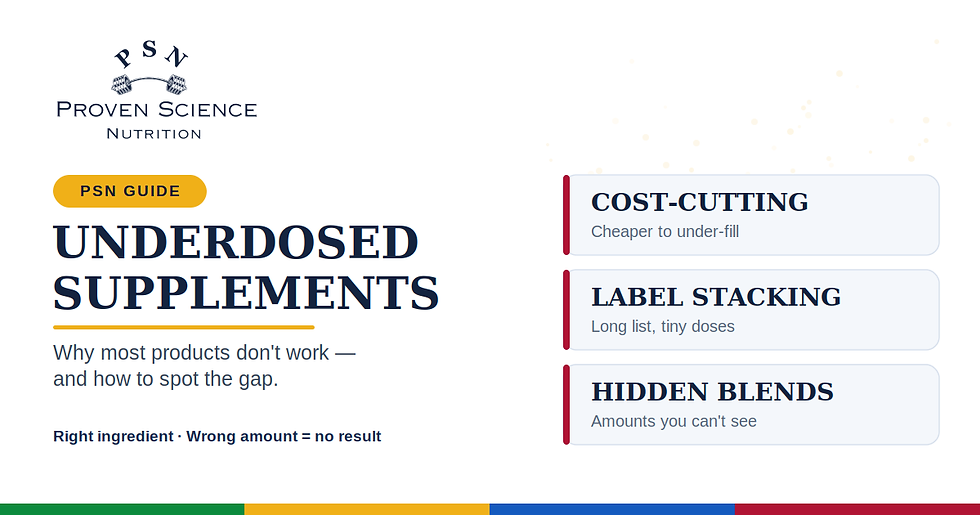
Transparency and dosing go hand in hand: a fully disclosed label is also what lets you confirm a product is properly dosed in the first place. If you want the companion piece on that, see Underdosed Supplements: Why Most Products Don't Work.
Build on a Foundation You Can Trust
Verified supplements are one part of a bigger picture — they work best on top of solid training and nutrition. If you want a plan built around you, my wife and PSN co-founder Michelle Oliveira coaches women and athletes through exactly this at Fit by Mi, helping you build the habits that make everything else — supplements included — actually count.
The Bottom Line
Because supplements aren't pre-approved, and because independent testing repeatedly finds gaps between the label and the bottle, verification is everything.[1][2] Real transparency means three things working together: independent third-party testing, certified GMP manufacturing, and clinical data you can actually access. Demand all three — proof, not promises — and you'll know exactly what you're putting in your body.
Science first. Results always.
Frequently Asked Questions
Are supplements approved by the FDA before they're sold? No. In the U.S., dietary supplements do not require pre-market FDA approval for safety or efficacy the way prescription drugs do. The FDA regulates supplements mainly after they're on the market, which is why independent third-party testing is so important for verifying quality.
What is third-party testing? Third-party testing is analysis performed by an independent laboratory with no stake in the outcome. It confirms a product's ingredient identity, potency (that doses match the label), and purity (that there are no undeclared substances or unsafe contaminants), and it produces a Certificate of Analysis documenting the results.
What is a Certificate of Analysis (COA)? A COA is a document from a testing laboratory showing exactly what was found in a product — its ingredient identity, potency, and contaminant screening results. An accessible COA lets you verify a supplement's contents yourself rather than relying on the label alone.
What does cGMP mean? cGMP stands for Current Good Manufacturing Practices — FDA-enforced regulations governing the methods, facilities, and controls used to manufacture a product. cGMP compliance helps ensure a supplement's identity, strength, quality, and purity are controlled throughout production.
Why can't I just trust the label? Because independent testing repeatedly finds discrepancies. Studies have found supplement content ranging far above and below label claims, and a meaningful share of sports supplements containing undeclared substances. A label is a claim; third-party testing and a COA are proof.
Written by Dr. Leandro Cordova, Ph.D., Co-Founder and Formulation Scientist at Proven Science Nutrition. With a Ph.D. and 15+ years in product development, Leo leads the development of every PSN formula — built on peer-reviewed science, with no proprietary blends.
Questions about our formulas, testing, or Certificates of Analysis? Reach us at contact@psnutrition.com.
*This article is for educational purposes only and is not medical advice. Consult a qualified healthcare professional before starting any supplement, especially if you have a medical condition or take medications.
References
Geyer H, Parr MK, Mareck U, Reinhart U, Schrader Y, Schänzer W. Analysis of non-hormonal nutritional supplements for anabolic-androgenic steroids — results of an international study. International Journal of Sports Medicine. 2004;25(2):124–129. doi:10.1055/s-2004-819955
LeBlanc ES, Perrin N, Johnson JD Jr, Ballatore A, Hillier T. Over-the-counter and compounded vitamin D: is potency what we expect? JAMA Internal Medicine. 2013;173(7):585–586. doi:10.1001/jamainternmed.2013.3812
U.S. Food & Drug Administration. Current Good Manufacturing Practices (CGMPs) for Food and Dietary Supplements. Accessed 2026.
U.S. Food & Drug Administration. Dietary Supplements: What You Need to Know. Accessed 2026.
Comments