Underdosed Supplements: Why Most Products Don't Work
Written by Dr. Leandro Cordova, Ph.D. — Co-Founder & Formulation Scientist at Proven Science Nutrition Science First. Results Always.
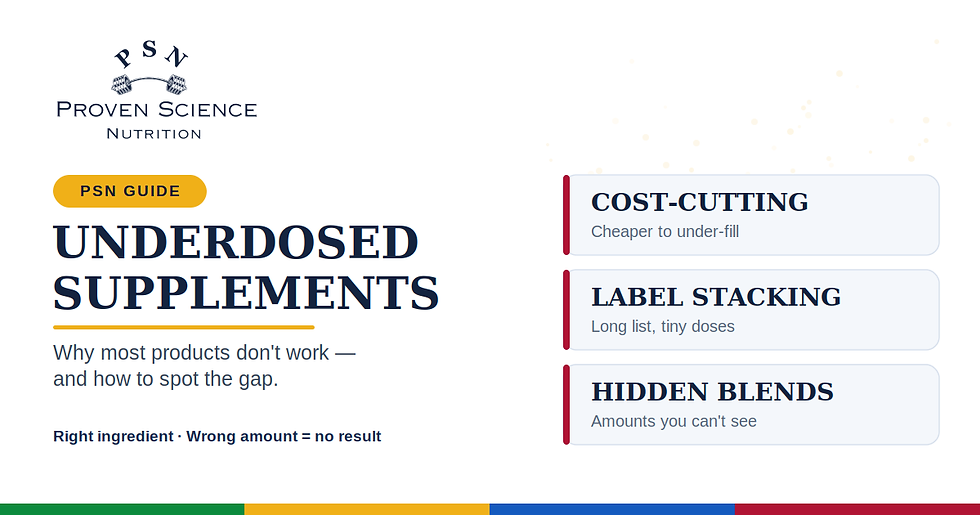
Here's an uncomfortable truth from inside the supplement industry: most products fail not because they contain the wrong ingredients, but because they contain the right ingredients in amounts too small to do anything. This is called underdosing, and once you learn to spot it, you'll never look at a supplement label the same way again.
As a formulation scientist, this is the problem I built Proven Science Nutrition to solve. Let me show you exactly how underdosing works, why it's so common, and how to tell whether the product in your hand will actually deliver.
What Is Underdosing?
Underdosing means a product contains less of an ingredient than the amount shown to be effective in scientific research. The ingredient is on the label — which lets the marketing claim it — but the quantity is a fraction of what studies actually used to produce a result.
It's the supplement equivalent of a medication at one-fifth the prescribed dose. The name on the bottle is right. The dose is wrong. And a right ingredient at the wrong amount produces the same thing as no ingredient at all: nothing.
The Underdosing Gap
This is easiest to see in a picture. Here's how much of the clinically effective dose a typical underdosed product actually delivers for several common ingredients:

Notice the pattern: many products deliver only 20–35% of the amount the research is built on. You're paying for a full product and getting a fraction of a dose.
Why Do Companies Underdose Their Products?
If underdosing doesn't work, why is it everywhere? Three reasons, and none of them are about your results:
1. Cost and margin. Effective ingredients cost money at effective doses. Cutting the dose of an expensive ingredient is the easiest way to protect a profit margin while keeping the name on the label.
2. "Label stacking." A label with fifteen trendy ingredients looks more impressive than one with five well-dosed ones. But cramming that many actives into one serving means each is present in a tiny amount — there simply isn't room in a scoop for fifteen full doses. The long list is for the shelf, not for you.
3. Palatability and format limits. Some effective doses are genuinely large. A full dose of an amino acid or electrolyte can be several grams, which affects taste, texture, and how many capsules you'd have to swallow. Cutting the dose makes the product easier to sell — and less effective.
What the Science Says About Effective Dosing
Dosing isn't a matter of opinion. For well-studied ingredients, researchers have established the amounts that actually produce results:
Ingredient | Clinically Effective Dose | What It's For |
3–5 g daily | Strength, power, muscle[1] | |
Whey protein (per serving) | 20–40 g | Muscle protein synthesis[3][4] |
Beta-alanine | 3.2–6.4 g daily | Muscular endurance[5] |
Citrulline malate | 6–8 g | Performance, blood flow[6] |
Meaningful amounts (often 500–1,000 mg+) | Hydration in athletes[2] |
Creatine is the clearest example. Decades of research and the International Society of Sports Nutrition point to 3–5 grams per day as the effective maintenance dose.[1] A "muscle blend" that includes 1 gram of creatine buried among a dozen other ingredients isn't giving you a creatine benefit — it's giving you a creatine claim.
The same logic applies across the board: protein needs to land in the 20–40 g range per serving to maximally stimulate muscle protein synthesis,[3][4] beta-alanine needs to reach the multi-gram range to build up and work,[5] and electrolyte products need meaningful sodium — not a token pinch — to actually support hydration in people who sweat.[2]
How to Spot an Underdosed Supplement
You can protect yourself with four quick label checks:
Compare against clinical doses. Look up the researched dose for the key ingredient (or check a trusted source), then see if the label matches. If the product has 1 g of something that needs 5 g, walk away.
Avoid proprietary blends. A "blend" lets a company list several ingredients under one total weight without disclosing how much of each is inside. It's the single easiest place to hide underdosing.
Scrutinize serving size vs. ingredient count. If a single small scoop claims to contain fifteen actives, the math doesn't work. Something has to give, and it's the doses.
Be skeptical of very long ingredient lists. More names aren't better. A short list of ingredients at full, disclosed doses beats a long list of fairy-dusted ones every time.
Why Underdosing Matters
Underdosing isn't a harmless marketing quirk — it costs you three ways:
Your money. You pay full price for a product engineered to underperform.
Your results. You do everything right — train hard, stay consistent — and blame yourself when a supplement that never had a chance doesn't deliver.
Your trust. Enough underdosed products, and people conclude "supplements don't work," when the truth is those supplements were never dosed to work.
What to Look for Instead
A supplement worth taking should:
Contain clinically effective doses of its key ingredients
Disclose every ingredient and its exact amount — no proprietary blends
Favor a focused formula of well-dosed actives over a sprawling list of tiny ones
Be transparent about sourcing and testing
The Proven Science Nutrition Standard
This is the entire reason PSN exists. Every formula we make follows one rule: clinically relevant doses, fully disclosed — chosen for how your body actually works, never trimmed to protect a margin or padded to pad a label. You can read more about that philosophy on Our Mission.
When you check our labels against the researched doses above, the numbers line up. That's not an accident — it's the standard. If you want the deeper dive on why dosing is everything, see our companion piece, Clinical Supplement Dosing Explained.
Beyond the Label: Get the Fundamentals Right
Even a perfectly dosed supplement is only an add-on to solid training and nutrition. If you want a plan built around you, my wife and PSN co-founder Michelle Oliveira coaches women and athletes through exactly this at Fit by Mi — helping you get the fundamentals right so the right supplements have something to build on.
The Bottom Line
Most supplements don't fail because of what's in them — they fail because of how much. Underdosing puts the right names on the label at the wrong amounts, and the result is a product that can't work no matter how consistent you are. Learn the clinical doses, demand full disclosure, favor focused formulas over long lists, and you'll stop wasting money on supplements that were never built to deliver.
Science first. Results always.
Frequently Asked Questions
What does "underdosed" mean in supplements? An underdosed supplement contains less of an ingredient than the amount research shows is effective. The ingredient appears on the label — supporting the marketing claim — but the quantity is too small to produce the benefit. It's a real ingredient at an ineffective dose.
Why do supplement companies underdose their products? Mainly to cut costs and protect margins, to "label stack" (list many trendy ingredients in tiny amounts so the label looks impressive), and to keep large-dose ingredients palatable or in a smaller serving. None of these reasons are about your results.
How can I tell if a supplement is underdosed? Compare the label amount against the clinically studied dose for that ingredient, avoid proprietary blends that hide individual amounts, and be skeptical of small servings claiming many active ingredients. If the dose is a fraction of what studies used, it's underdosed.
What's a proprietary blend and why is it a problem? A proprietary blend lists several ingredients under a single total weight without disclosing how much of each is included. It lets companies hide underdosing — you can't verify you're getting an effective amount of anything inside the blend.
Is more ingredients always better? No — usually the opposite. A long ingredient list often means each active is present in a tiny, ineffective amount because there's no room for full doses of all of them. A focused formula with a few well-dosed, fully disclosed ingredients is far more effective.
Written by Dr. Leandro Cordova, Ph.D., Co-Founder and Formulation Scientist at Proven Science Nutrition. With a Ph.D. and 15+ years in product development, Leo leads the development of every PSN formula — built on peer-reviewed science, with no proprietary blends.
Questions about our formulas or the research behind them? Reach us at contact@psnutrition.com.
*This article is for educational purposes only and is not medical advice. Consult a qualified healthcare professional before starting any supplement, especially if you have a medical condition or take medications.
References
Kreider RB, Kalman DS, Antonio J, et al. International Society of Sports Nutrition position stand: safety and efficacy of creatine supplementation in exercise, sport, and medicine. Journal of the International Society of Sports Nutrition. 2017;14:18. doi:10.1186/s12970-017-0173-z
Sawka MN, Burke LM, Eichner ER, Maughan RJ, Montain SJ, Stachenfeld NS. American College of Sports Medicine position stand: Exercise and fluid replacement. Medicine & Science in Sports & Exercise. 2007;39(2):377–390. doi:10.1249/mss.0b013e31802ca597
Jäger R, Kerksick CM, Campbell BI, et al. International Society of Sports Nutrition Position Stand: protein and exercise. Journal of the International Society of Sports Nutrition. 2017;14:20. doi:10.1186/s12970-017-0177-8
Morton RW, Murphy KT, McKellar SR, et al. A systematic review, meta-analysis and meta-regression of the effect of protein supplementation on resistance training-induced gains in muscle mass and strength in healthy adults. British Journal of Sports Medicine. 2018;52(6):376–384. doi:10.1136/bjsports-2017-097608
Trexler ET, Smith-Ryan AE, Stout JR, et al. International Society of Sports Nutrition position stand: Beta-Alanine. Journal of the International Society of Sports Nutrition. 2015;12:30. doi:10.1186/s12970-015-0090-y
Pérez-Guisado J, Jakeman PM. Citrulline malate enhances athletic anaerobic performance and relieves muscle soreness. Journal of Strength and Conditioning Research. 2010;24(5):1215–1222. doi:10.1519/JSC.0b013e3181cb28e0

Comments